Grade your
entire class
in minutes

GradeLab AI grades student work and assigns a
score. It's built for teachers and powered by
manual review for grades that won't harm, build
structure and foster grading joy. On Rails.
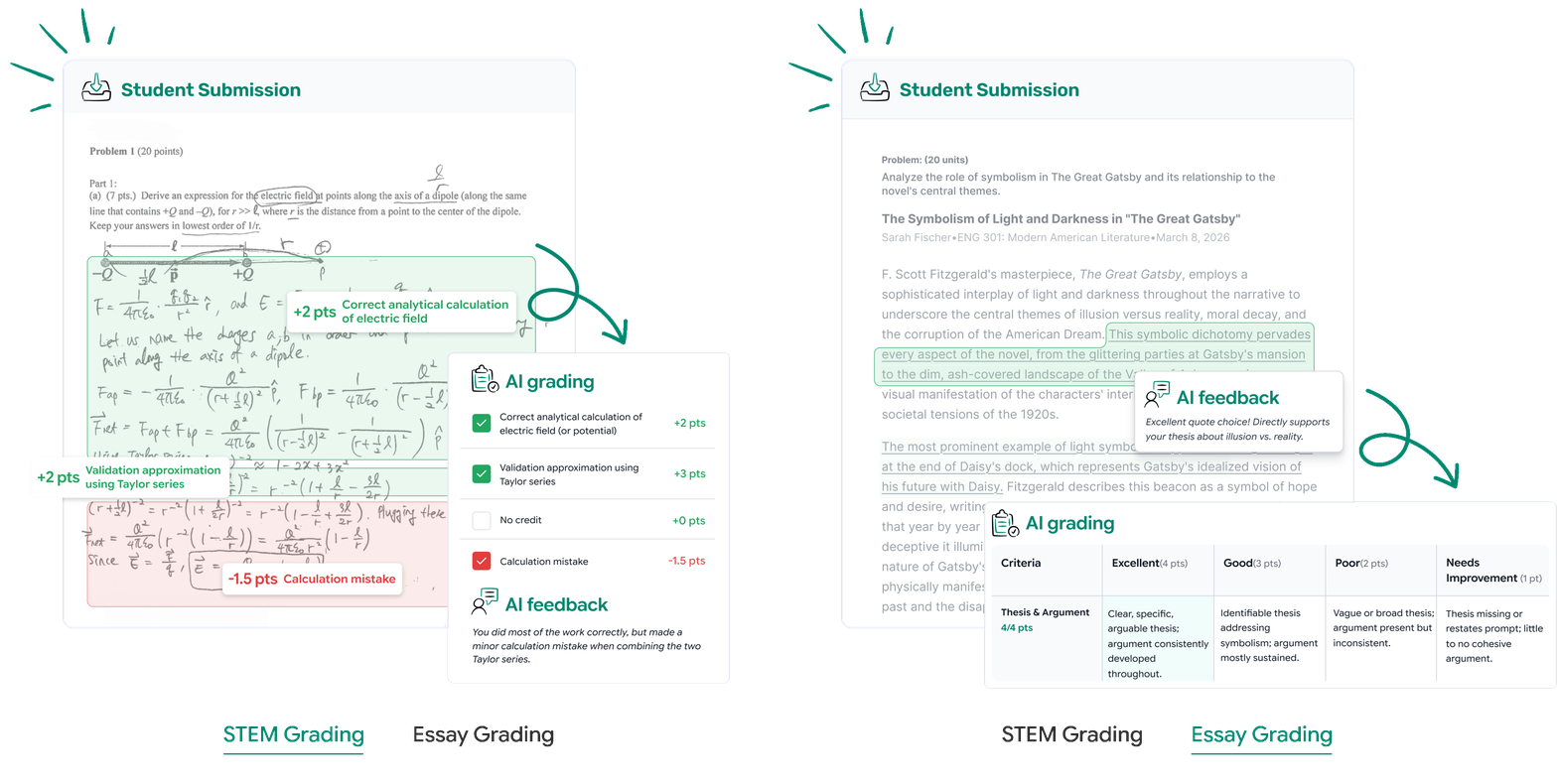
GradeLab AI grading platform demo

Features

AI grading

Given a rubric, GradeLab AI grades student submissions and shows its confidence level.

AI Model 1: ChatGPT
Complete
AI Model 2: Claude
Analyzing...
AI Model 3: Gemini
Complete

AI feedback generation

Personalized student feedback. You can review, edit, and release.

AI rubric generation

GradeLab generates rubrics for you to review and deploy for your assignments.

Fully Correct
+5 pts
Partial, correct analytical estimation of vertical, text
+3 pts
Simple valid approximation using heuristic
+2 pts
Incorrect
0 pts

Optimize for your course

As you do grades rubrics, and feedback, GradeLab learns your preferences to optimize grading for your course.

AI grader calibration

Adapting Improving
1
Grade
2
Edit
3
Learn

AI Essay Grader

AI-powered essay grading with personalized feedback, citation checks, and adaptive scoring

Essay Submission

The Impact of the Printing Press on Renaissance Intellectual Culture

Johannes Gutenberg's invention of the movable-type printing press around 1440 fundamentally reshaped the intellectual landscape of Renaissance Europe, democratizing access to knowledge and accelerating the spread of new ideas across the continent.

The rapid proliferation of printed books dismantled the Church's monopoly on learning, enabling humanist scholars to circulate classical texts and critical inquiry far beyond the walls of monastic libraries and cathedral schools.

Print shops became vibrant hubs of collaboration where editors, translators, and typesetters standardized vernacular language and preserved knowledge with unprecedented fidelity, reducing the errors that plagued hand-copied manuscripts.

Ultimately, the printing press laid the technological foundation for the Scientific Revolution and the Reformation, permanently transforming how humanity produced, validated, and shared knowledge.

AI essay grading
Thesis Statement
5/5
Evidence & Support
4/5
Analysis & Interpretation
5/5
Organization
4/5
Citation & Sources
5/5
Grammar & Mechanics
4/5
Total Score
27/30

AI essay grading dashboard showing rubric scores and feedback

Personalize feedback

AI generates and you set student feedback for specific improvement.

Save writing time

Essays that once took 20 minutes now take 5 minutes to grade.

Optimize & Uncover

See patterns in learning over time to adjust your teaching.

Data Security is our Priority

All learner data is encrypted at rest and in transit. GradeLab has achieved the industry-standard encryption to prevent unauthorized access.

FERPA

Family Educational Rights

SOC 2 Type II

System and Organization Controls

HIPAA

Health Insurance Portability

SOC3

Trust Services Criteria

gradelab.ae/dashboard

Training Assignments

Assignment
Progress
Status
Graded
Essay Analysis - Module 1
85%
Active
Research Paper Draft
60%
Active
Final Exam Questions
100%
Completed

Scale consistent grading across your institution

AI-assisted grading that standardizes feedback quality, and reduces instructor's burnout

Here are some frequently asked questions about GradeLab

Getting started with GradeLab AI Grader is simple. First, create an account and connect your LMS platform. Upload your assignment rubric and student submissions. Our AI will analyze and grade the submissions based on your criteria. You can review, edit, and approve the grades before releasing them to students. The platform integrates seamlessly with Canvas, Blackboard, Moodle, and other popular LMS systems.

Yes, GradeLab is fully FERPA compliant. We take student data privacy seriously and have implemented comprehensive security measures including 256-bit encryption, SOC 2 Type II certification, and regular security audits. All student data is encrypted both at rest and in transit. We never share or sell student information, and instructors maintain full control over their data. Our compliance extends to GDPR, HIPAA, and other international data protection standards.

GradeLab AI Grader supports a wide range of subjects across humanities, STEM, and professional disciplines. This includes English literature, history, philosophy, mathematics, computer science, physics, chemistry, biology, business, law, and more. Our AI is trained on diverse academic content and can adapt to subject-specific grading criteria. Whether you're grading essays, problem sets, research papers, or coding assignments, GradeLab provides accurate and consistent feedback tailored to your field.

Yes, GradeLab's effectiveness has been validated through multiple research studies and real-world implementations. Independent studies show that our AI grading achieves 95% consistency with expert human graders. Universities using GradeLab report a 75% reduction in grading time while maintaining or improving feedback quality. Our research partnerships with leading institutions have resulted in peer-reviewed publications demonstrating improved student outcomes and instructor satisfaction. We continuously validate our models against diverse datasets to ensure accuracy and fairness.

If you have additional questions not covered here, we're here to help! You can reach our support team via email at support@gradelab.ae, schedule a demo call with our product specialists, or visit our comprehensive documentation center. We also offer live chat support during business hours and host weekly webinars for new users. Our community forum is another great resource where educators share tips and best practices for using GradeLab effectively.